 Integrais - Duplos, Triplos, de Linha e de Superfície
M. Olga Baptista
Integrais - Duplos, Triplos, de Linha e de Superfície
M. Olga Baptista

I – Introdução II – Integrais Duplos III – Integrais Triplos IV – Integral ao Longo de Uma Linha V – Integrais de Superfície  Introduction to Differential Equations and Their Applications
Stanley J. Farlow
Introduction to Differential Equations and Their Applications
Stanley J. Farlow
This text is intended for a one-term course in introductory differential equations and is designed for students in pure and applied mathematics who have had a course in calculus. The text presents a balance of mathematical rigour and intuitive thinking. The illustrations aim to enhance the conceptual material and allow students to visualize the mathematics. The treatment of chaotic dynamical systems introduces students to the basic ideas surrounding chaotic motion. Problem sets, which contain computer applications, are carefully graduated from the routine to the more challenging and extension exercises asking students to expand on the material are included to pique student interest. Brief historical notes place topics in their proper historical and cultural context.  Introduction to Electrodynamics
David J. Griffiths
Introduction to Electrodynamics
David J. Griffiths
For junior/senior-level electricity and magnetism courses. This book is known for its clear, concise and accessible coverage of standard topics in a logical and pedagogically sound order. The Third Edition features a clear, accessible treatment of the fundamentals of electromagnetic theory, providing a sound platform for the exploration of related applications (ac circuits, antennas, transmission lines, plasmas, optics, etc.). Its lean and focused approach employs numerous examples and problems.  An Introduction to Error Analysis: The Study of Uncertainties in Physical Measurements
John R. Taylor
An Introduction to Error Analysis: The Study of Uncertainties in Physical Measurements
John R. Taylor

This best-selling text by John Taylor, now released in its second edition, introduces the study of uncertainties to lower division science students. Assuming no prior knowledge, the author introduces error analysis through the use of familiar examples ranging from carpentry to well-known historic experiments. Pertinent worked examples, simple exercises throughout the text, and numerous chapter-ending problems combine to make the book ideal for use in physics, chemistry, and engineering lab courses. The first edition of this book has been translated into six languages. 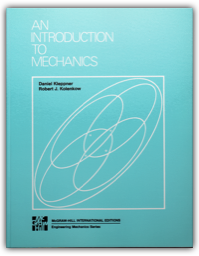 An Introduction to Mechanics
Daniel Kleppner, Robert J. Kolenkow
An Introduction to Mechanics
Daniel Kleppner, Robert J. Kolenkow

There is good reason for the tradition that students of science and engineering start college physics with the study of mechanics: mechanics is the cornerstone of pure and applied science. The concept of energy, for example, is essential for the study of the evolution of the universe, the properties of elementary particles, and the mechanisms of biochemical reactions. The concept of energy is also essential to the design of a cardiac pacemaker and to the analysis of the limits of growth of industrial society. However, there are difficulties in presenting an introductory course in mechanics which is both exciting and intellectually rewarding. Mechanics is a mature science and a satisfying discussion of its principies is easily lost in a superficial treatment. At the other extreme, attempts to "enrich" the subject by emphasizing advanced topics can produce a false sophistication which emphasizes technique rather than understanding. This text was developed from a first-year course which we taught for a number of years at the Massachusetts Institute of Technology and, earlier, at Harvard University. We have tried to present mechanics in an engaging form which offers a strong base for future work in pure and applied science. Our approach departs from tradition more in depth and style than in the choice of topics; nevertheless, it reflects a view of mechanics held by twentieth-century physicists. 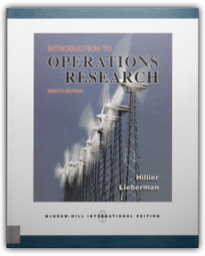 Introduction to Operations Research
Frederick Hillier, Gerald Lieberman
Introduction to Operations Research
Frederick Hillier, Gerald Lieberman
The 8th edition of "Introduction to Operations Research" remains the classic operations research text, while incorporating a wealth of state-of-the-art, user-friendly software and more coverage of modern OR topics. The hallmark features of this edition include solid coverage of fundamentals and state-of-the-practice operations research software used in conjunction with examples from the text. This edition will also feature the latest developments in OR, such as metaheuristics, simulation, and spreadsheet modeling. 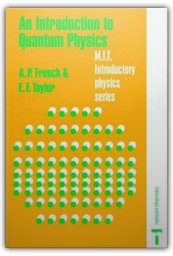 An Introduction to Quantum Physics
A.P. French, Edwin F. Taylor
An Introduction to Quantum Physics
A.P. French, Edwin F. Taylor
Provides comprehensive coverage of all the fundamentals of quantum physics. Full mathematical treatments are given. Uses examples from different areas of physics to demonstrate how theories work in practice. Text derived from lectures delivered at Massachusetts Institute of Technology. 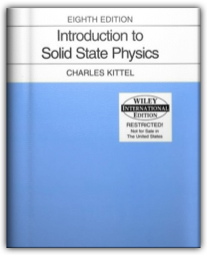 Introduction to Solid State Physics
Charles Kittel
Introduction to Solid State Physics
Charles Kittel

Since the publication of the first edition over 50 years ago, Introduction to Solid State Physics has been the standard solid state physics text for physics students. The author's goal from the beginning has been to write a book that is accessible to undergraduates and consistently teachable. The emphasis in the book has always been on physics rather than formal mathematics. With each new edition, the author has attempted to add important new developments in the field without sacrificing the book's accessibility and teachability.  Introdução aos Circuitos Eléctricos e Electrónicos
Manuel de Medeiros Silva
Introdução aos Circuitos Eléctricos e Electrónicos
Manuel de Medeiros Silva
PREFÁCIO
 Introdução à Análise Matemática
J. Campos Ferreira
Introdução à Análise Matemática
J. Campos Ferreira
PREFÁCIO  Introdução à Álgebra Linear
Ana Paula Santana, João Filipe Queiró
Introdução à Álgebra Linear
Ana Paula Santana, João Filipe Queiró
Este livro foi pensado para servir de texto de apoio às disciplinas que tratam de Álgebra Linear, sejam elas semestrais ou anuais, em cursos de Engenharia, Economia, Ciências e Matemática. Com esse objectivo, a apresentação dos assuntos é feita de maneira sistemática e rigorosa, mas de forma modular. Inicialmente é abordada a parte mais concreta da Álgebra Linear: matrizes, sistemas e determinantes. Continua-se com o estudo de ?n e seus subespaços, do ponto de vista vectorial e métrico, e com breve referência ao caso abstracto. Segue-se a Geometria Analítica do 1.º grau e um longo capítulo sobre vectores próprios e valores próprios, incluindo algumas aplicações interessantes, como a compressão de imagens usando a decomposição dos valores singulares, os sistemas dinâmicos lineares discretos, a análise de componentes principais em Estatística e o funcionamento do Google. O material coberto nestes sete primeiros capítulos é adequado para nele se basear uma disciplina semestral. Os capítulos finais são dedicados à Álgebra Linear abstracta, estudando-se os espaços vectoriais gerais sobre corpos arbitrários (incluindo os espaços de dimensão infinita), as transformações lineares entre eles e os espaços com produto interno.  Introdução à Álgebra Linear e Geometria Analítica
F. R. Dias Agudo
Introdução à Álgebra Linear e Geometria Analítica
F. R. Dias Agudo
Este livro foi preparado especificamente para uma primeira disciplina semestral de Álgebra Linear para alunos do primeiro ano das licenciaturas em Engenharia, Física ou Matemática do IST (Universidade Técnica de Lisboa), onde tem sido utilizado desde 1985 em versões que foram revistas de ano para ano até se chegar à forma presente. |
 Made with Delicious Library