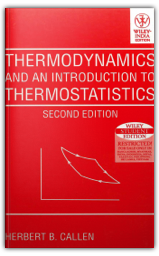
Thermodynamics and an introduction to Thermostatistics
Herbert B. Callen
It is the only text to cover both thermodynamic and statistical mechanics—allowing students to fully master thermodynamics at the macroscopic level. Presents essential ideas on critical phenomena developed over the last decade in simple, qualitative terms. This new edition maintains the simple structure of the first and puts new emphasis on pedagogical considerations. Thermo statistics is incorporated into the text without eclipsing macroscopic thermodynamics, and is integrated into the conceptual framework of physical theory.
8126508124
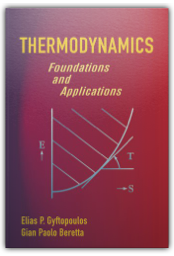
Thermodynamics: Foundations and Applications
Elias P. Gyftopoulos, Gian Paolo Beretta
Designed by two MIT professors, this authoritative text transcends the limitations and ambiguities of traditional treatments to develop a deep understanding of the fundamentals of thermodynamics and its energy-related applications. Basic concepts and applications are discussed in complete detail, with attention to generality, rigorous definitions, and logical consistency. More than 300 solved problems span a wide range of realistic energy systems and processes.
0486439321
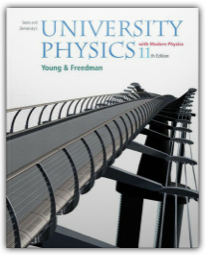
University Physics with Modern Physics with Mastering Physics
Hugh D. Young, Roger A. Freedman
With its time-tested problems, pioneering conceptual and visual pedagogy, and next-generation media package, the Eleventh Edition of Young and Freedman's University Physics is the classic physics book with an eye on the future. Using Young & Freedman's research-based ISEE (Identify, Set up, Execute, Evaluate) problem-solving strategy, readers develop the physical intuition and problem-solving skills required to tackle the book's extensive high-quality problem sets that have been developed and refined over the past five decades. The completely redesigned, pedagogically consistent artwork and diagrams integrate seamlessly with the book to help readers better visualize key concepts.
Mechanics
1. Units, Physical Quantities, and Vectors
2. Motion Along a Straight Line
3. Motion in Two or Three Dimensions
4. Newton's Laws of Motion
5. Applying Newton's Laws
6. Work and Kinetic Energy
7. Potential Energy and Energy Conservation
8. Momentum, Impulse, and Collisions
9. Rotation of Rigid Bodies
10. Dynamics of Rotational Motion
11. Equilibrium and Elasticity
12. Gravitation
13. Periodic Motion
14. Fluid Mechanics
15.
16. Waves/Acoustics
17.
18. Mechanical Waves
19. Sound and Hearing
20.
21. Thermodynamics
22.
23. Temperature and Heat
24. Thermal Properties of Matter
25. The First Law of Thermodynamics
26. The Second Law of Thermodynamics
27.
28. Electromagnetism
29.
30. Electric Charge and Electric Field
31. Gauss's Law
32. Electric Potential
33. Capacitance and Dielectrics
34. Current, Resistance, and Electromotive Force
35. Direct-Current Circuits
36. Magnetic Field and Magnetic Forces
37. Sources of Magnetic Field
38. Electromagnetic Induction
39. Inductance
40. Alternating Current
41. Electromagnetic Waves
42.
43. Optics
44.
45. The Nature and Propagation of Light
46. Geometric Optics and Optical Instruments
47. Interference
48. Diffraction
49.
50. Modern Physics
51.
52. Relativity
53. Photons, Electrons, and Atoms
54. The Wave Nature of Particles
55. Quantum Mechanics
56. Atomic Structure
57. Molecules and Condensed Matter
58. Nuclear Physics
59. Particle Physics and Cosmology
0321204697
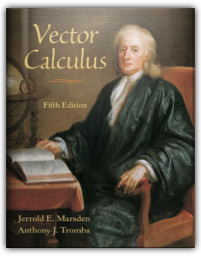
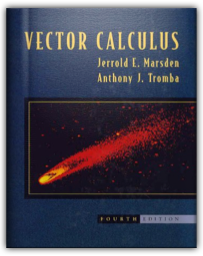
Vector Calculus
Jerrold E. Marsden, Anthony Tromba
Now in its fifth edition, Vector Calculus helps students gain an intuitive and solid understanding of this important subject. The book’s careful account is a contemporary balance between theory, application, and historical development, providing it’s readers with an insight into how mathematics progresses and is in turn influenced by the natural world.
0716749920
Vector Calculus
Jerrold E. Marsden, Anthony J. Tromba
This acclaimed course in the calculus of functions of several variables and vector analysis is aimed mainly at second-year undergraduates. Marsden and Tromba provide a concrete, student-oriented text that fosters computational skills and intuitive understanding. The Fourth Edition maintains the balance between theory, applications, optional materials and historical notes present in earlier editions, but has been refined throughout. "This is a superbly produced book, whose clear and orderly presentation and informative diagrams immediately invite closer study ...The best way to evaluate a textbook is to teach from it, and it is clear from the companion study guide by Pao and Soon that it has passed this test." The Mathematical Gazette Supplements: Student Guide/Instructor's Manual
0716724324
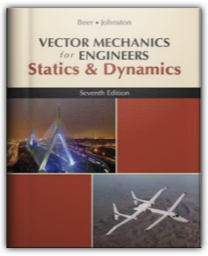
Vector Mechanics for Engineers, Statics and Dynamics
Ferdinand P. Beer, Jr., E. Russell Johnston, Elliot R. Eisenberg, William E. Clausen, George H. Staab, Ferdinand Beer, Elliot Eisenberg, William Clausen, George Staab
For the past forty years Beer and Johnston have been the uncontested leaders in the teaching of undergraduate engineering mechanics. Over the years their textbooks have introduced significant theoretical and pedagogical innovations in statics, dynamics, and mechanics of materials education. At the same time, their careful presentation of content, unmatched levels of accuracy, and attention to detail have made their texts the standard for excellence. The new Seventh Edition of Vector Mechanics for Engineers: Statics and Dynamics continues this tradition. The seventh edition is complemented by a media and supplement package that is targeted to address core course needs for both the student and the instructor.
0072931108
|
Vibrações e Ondas
João Paulo Silva
O livro Vibrações e Ondas cobre essencialmente todos os tópicos de um curso introdutório em vibrações e ondas. Os temas são abordados recorrendo, geralmente, a exemplos de mecânica ou de eletromagnetismo, sendo também dados vários exemplos da física subatómica, área de especialidade do autor.
Este livro interessa aos alunos dos cursos de física e engenharia. Frequentemente o estudo de vibrações vem associado a outros temas (termodinâmica, óptica, etc.), e, nestes casos, o presente livro cobrirá o programa de vibrações.
O livro tem um fio condutor que leva o leitor de assuntos básicos como a equação de movimento do oscilador harmónico, até tópicos mais avançados como fenómenos dissipativos e dispersivos ou ondas eletromagnéticas, passando por oscilações amortecidas, oscilações forçadas, ondas estacionárias, propagação de ondas, reflexão e transmissão de ondas entre outros temas. Os diferentes assuntos vão sendo introduzidos de um modo coerente e claro, com vários exemplos e exercícios propostos.
Constança Providência
Centro de Física Computacional e Departamento de Física,
Faculdade de Ciências da Universidade de Coimbra
O presente texto é dirigido a alunos de engenharia e isso reflete-se na maneira como os cálculos são conduzidos, na maioria das aplicações discutidas, bem como no material escolhido. Neste contexto, considero este livro um excelente texto que vai colmatar uma lacuna existente na edição científica em língua portuguesa, e será certamente uma excelente referência para alunos de engenharia nos institutos politécnicos e nas universidades portuguesas.
Um argumento forte a favor da publicação deste livro é que, tanto quanto sei, será o primeiro livro deste género bem adaptado para cursos de engenharia em Portugal. Além disso, gostaria de sublinhar a óptima lógica do texto que começa com um oscilador e vai até uma onda eletromagnética.
Vladimir Konotop
Centro de Física Teórica e Computacional e Departamento de Física
Faculdade de Ciências da Universidade de Lisboa
JOÃO PAULO SILVA é Licenciado (Universidade de Lisboa, 1989), Mestre e Doutor (Universidade de Carnegie Mellon, 1992 e 1994) e Agregado (Instituto Superior Técnico - UTL, 2002) em Física. Fez pós-doutoramento na Universidade de Valência (1994-1995), foi “Fulbright fellow” no Stanford Linear Accelerator Center da Universidade de Stanford (1999-2000) e cientista visitante no Instituto Weizmann, na Universidade de Cornell e no CERN. Leccionou na Universidade de Carnegie Mellon e lecciona desde 1995 no Instituto Superior de Engenharia de Lisboa, onde é, desde 2002, Professor Coordenador com Agregação. É membro do Centro de Física Teórica de Partículas do Instituto Superior Técnico desde a sua fundação. Foi co-galardoado com o Prémio Gulbenkian de Ciência em 1994 e em 2001. Dedica-se à teoria e fenomenologia das interacções electrofracas, com especial destaque para a violação de CP e o mecanismo de Higgs. É co-autor dos livros “CP Violation”, editado pela Oxford University Press, e “Exploring Fundamental Particles”, editado pela CRC Press/Taylor and Francis.
1 OSCILADOR SEM AMORTECIMENTO
1.1 A equação do oscilador harmónico e o movimento harmónico simples
1.2 O plano complexo
1.3 Movimento harmónico simples, fasores e movimento circular uniforme
1.4 O circuito LC
1.5 Massa presa num fio
1.6 Energia de um oscilador harmónico
1.7 O oscilador harmónico como arquétipo universal
Problemas
2 OSCILADOR COM AMORTECIMENTO
2.1 Oscilador com atrito fluido
2.2 Amortecimento fraco
2.3 Amortecimento forte
2.4 Amortecimento crítico
2.5 Sumário
2.6 O circuito RLC
Problemas
3 OSCILADOR FORÇADO
3.1 Forçamento harmónico
3.2 Oscilador forçado sem amortecimento
3.3 Um pormenor matemático
3.4 Ressonância da posição no oscilador forçado com amortecimento
3.5 Ressonância da velocidade no oscilador forçado com amortecimento
3.6 A importância da curva de potência
Problemas
4 OSCILADORES ACOPLADOS
4.1 Tipos de acoplamento
4.2 Duas massas presas num fio
4.3 O pêndulo duplo
4.4 O transformador: osciladores acoplados e forçados
4.5 Energia de osciladores acoplados
4.6 Sistemas com N osciladores
4.7 Circuito elétrico e Física de Partículas
Problemas
5 ONDAS ESTACIONÁRIAS
5.1 A equação das ondas
5.2 Ondas estacionárias: equação das ondas independente do tempo
5.3 Corda com extremidades fixas
5.4 Cordas que partem do repouso: séries de Fourier
5.5 Corda puxada centralmente
5.6 Impulso rectangular
5.7 Energia de uma corda vibrante
5.8 Cordas com extremidades livres
5.9 Corda forçada
Problemas
6 PROPAGAÇÃO DE ONDAS
6.1 Ondas progressivas
6.2 Equações simplificadas para ondas progressivas
6.3 Tipos de ondas
6.4 Ondas estacionárias e ondas progressivas
6.5 Sobreposição de ondas
6.6 Impulsos: integral de Fourier
Problemas
7 IMPEDÂNCIA E ENERGIA
7.1 Impedância do meio
7.2 Energia das ondas
7.3 Potência cedida à onda
Problemas
8 REFLEXÃO E TRANSMISSÃO DE ONDAS
8.1 Reflexão numa extremidade fixa
8.2 Reflexão numa extremidade livre
8.3 Interface entre dois meios
8.3.1 Z2 = 0
8.3.2 0 < Z2 < Z1
8.3.3 Z2 = Z1
8.3.4 Z1 < Z2 < infinito
8.3.5 Z2 -> infinito
8.4 Conservação da energia na interface
8.5 Adaptação de impedâncias
8.6 Terminação não reflexiva
Problemas
9 ONDAS EM DUAS E TRÊS DIMENSÕES
9.1 Equação das ondas em duas dimensões
9.2 Equação das ondas em três dimensões
9.2.1 Ondas planas
9.2.2 Ondas esféricas e atenuação geométrica
9.3 Intensidade das ondas sonoras: decibel
10 OUTRAS ONDAS: DISSIPAÇAO E DISPERSÇÃO
10.1 O que é uma equação das ondas?
10.2 Atenuação dissipava
10.2.1 Atenuação muito fraca
10.2.2 Atenuação muito forte
10.2.3 Impedância complexa
10.3 Equação da linha de transmissão„o
10.4 Ondas dispersivas
10.4.1 Sobreposição de ondas com dispersão
10.4.2 Alteração das frequências dos modos normais
10.4.3 Alargamento do pacote de ondas
Problemas
11 ONDAS ELECTROMAGNÉTICAS
11.1 As equações de Maxwell
11.2 A equações das ondas eletromagnéticas
11.3 Ondas planas
11.4 Polarização
11.5 Ondas eletromagnéticas em condutores
11.6 Guias de ondas
11.7 Frequência de corte e ondas evanescentes
Problemas
A NÚMEROS COMPLEXOS
A.1 Notação
A.2 Operações
A.3 Exponencial complexa
B EQUAÇÕES DIFERENCIAIS ORDINÁRIAS
C OPERADORES DIFERENCIAIS
BIBLIOGRAFIA
SOLUÇÕES DE ALGUNS EXERCÍCIOS E PROBLEMAS
9898481145
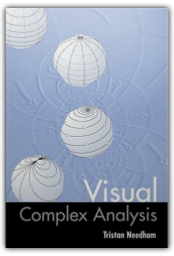
Visual Complex Analysis
Tristan Needham
"... a fascinating and refreshing look at a familiar subject... essential reading for anybody with any interest at all in this absorbing area of mathematics." - Times Higher Education Supplement
"Visual Complex Analysis is a delight, and a book after my own heart. By his innovative and exclusive use of the geometrical perspective, Tristan Needham uncovers many surprising and largely unappreciated aspects of the beauty of complex analysis." - Roger Penrose
"One of the saddest developments in school mathematics has been the downgrading of the visual for the formal. I'm not lamenting the loss of traditional Euclidean geometry, despite its virtues, because it too emphasised stilted formalities. But to replace our rich visual tradition by silly games with 2x2 matrices has always seemed to me to be the height of folly. It is therefore a special pleasure to see Tristan Needham's Visual Complex Analysis with its elegantly illustrated visual approach. Yes, he has 2x2 matrices—but his are interesting." - Ian Stewart, New Scientist, 11 October 1997
"... an engaging, broad, thorough, and often deep, development of undergraduate complex analysis and related areas from a geometric point of view. The style is lucid, informal, reader-friendly, and rich with helpful images (e.g. the complex derivative as an "amplitwist"). A truly unusual and notably creative look at a classical subject." - Paul Zorn, American Mathematical Monthly
"I was delighted when I came across [Visual Complex Analysis]. As soon as I thumbed through it, I realized that this was the book I was looking for ten years ago." - Ed Catmull, founder of Pixar
0198534469
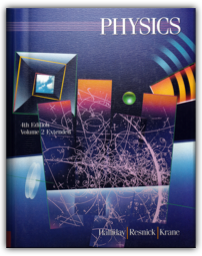
Volume 2 Extended, Physics, 4th Edition, Extended Version
David Halliday, Robert Resnick, Kenneth S. Krane
Presents a complete, accurate and rigorous study of physics while bringing it forward into the '90s and beyond. The Fourth Edition of volumes 1 and 2 is concerned with mechanics and E&M/Optics. New features include: expanded coverage of classic physics topics, substantial increases in the number of in-text examples which reinforce text exposition, the latest pedagogical and technical advances in the field, numerical analysis, computer-generated graphics, computer projects and much more.
0471548049
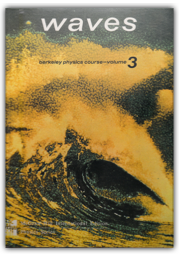
Waves: Berkeley Physics Course, Vol. 3 WAVES
Frank S. Crawford Jr.
Table of contents
Chapter 1: Free Oscillations of Simple Systems
Chapter 2: Free Oscillations of Systems with Many Degrees of Freedom
Chapter 3: Forced Oscillations
Chapter 4: Traveling Waves
Chapter 5: Reflection
Chapter 6: Modulations, Pulses, and Wave Packets
Chapter 7: Waves in Two and Three Dimensions
Chapter 8: Polarization
Chapter 9: Interference and Diffraction Supplementary Topics
Appendices
Supplementary Reading
Index
0071132325
|





 Made with Delicious Library