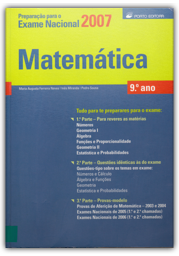
 Preparação para o Exame Nacional 2007 • Matemática 9.º ano
Maria Augusta Ferreira Neves • Inês Miranda • Pedro Sousa
Preparação para o Exame Nacional 2007 • Matemática 9.º ano
Maria Augusta Ferreira Neves • Inês Miranda • Pedro Sousa

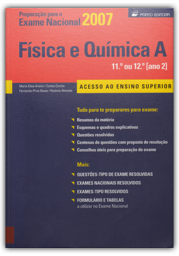 Preparação para o Exame Nacional 2207 • Física e Química A • 11º ou 12º
Maria Elisa Arieiro • Carlos Corrêa • Fernando Pires Basto • Noémia Almeida
Preparação para o Exame Nacional 2207 • Física e Química A • 11º ou 12º
Maria Elisa Arieiro • Carlos Corrêa • Fernando Pires Basto • Noémia Almeida
 Preparar os Testes - Física e Química 10º Ano - Parte 2 (Física)
Alzira Finteiro, Ana Soares dos Reis
Preparar os Testes - Física e Química 10º Ano - Parte 2 (Física)
Alzira Finteiro, Ana Soares dos Reis
 Primitivação - Matemática, Ensino Superior
Maria dos Anjos Fonseca Saraiva, Maria Aldina Carvalho Silva
Primitivação - Matemática, Ensino Superior
Maria dos Anjos Fonseca Saraiva, Maria Aldina Carvalho Silva
 O Princípio da Relatividade
H. A. Lorentz, A. Einstein, H. Minkowski
O Princípio da Relatividade
H. A. Lorentz, A. Einstein, H. Minkowski
Este livro baseia-se em aulas de Electrodinâmica Clássica, do 3º ano do mestrado integrado em Engenharia Física Tecnológica do Instituto Superior Técnico.  Princípios de Análise Matemática Aplicada
Jaime Carvalho e Silva
Princípios de Análise Matemática Aplicada
Jaime Carvalho e Silva
CAPÍTULO I funções
I.1 Definição
I.2 Gráfico
I.3 Funções injectivas
I.4 Funções sobrejectivas
I.5 Funções monótonas
I.5 Funções limitadas
I.6 Funções pares e ímpares
I.7 Funções periódicas
I.8 Mini-Atlas de funções
I.8.A Funções polinomiais
I.8.B Funções irracionais
I.8.C Fracções racionais
I.8.D Funções
trigonométricas directas
I.8.E Funções trigonométricas inversas
I.8.F Função exponencial
I.8.G Função logarítmica
I.8.H Funções f(x)^g(x)
I.8.I Funções hiperbólicas
I.8.J Funções hiperbólicas inversas
I.8.K Funções descontínuas
Quebra-cabeças n(o) 1
I.9 Escalas logarítmicas e semi-logarítmicas
I.10 Crescimento exponencial 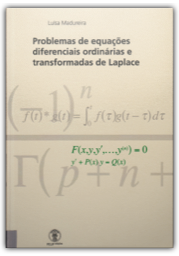 Problemas de Equações Diferenciais Ordinárias e Tranformadas de Laplace
Luísa Madureira
Problemas de Equações Diferenciais Ordinárias e Tranformadas de Laplace
Luísa Madureira
Este é um livro de problemas, com alguns exercícios resolvidos, destinado essencialmente aos cursos de Engenharia que incluam um semestre de equações diferenciais. São abordadas apenas as equações diferenciais ordinárias e é incluído um capítulo de Transformadas de Laplace com aplicações. O primeiro capítulo trata as equações diferenciais ordinárias de primeira ordem, o segundo as de ordem n (onde se abordam em particular as soluções por séries de potências) e o terceiro os sistemas. No quarto capítulo estudam-se as Transformadas de Laplace com aplicação às equações diferenciais incluindo o Teorema da Convolução.  Quantum Mechanics, Vol. 2
Claude Cohen-Tannoudji, Bernard Diu, Frank Laloe
Quantum Mechanics, Vol. 2
Claude Cohen-Tannoudji, Bernard Diu, Frank Laloe


Beginning students of quantum mechanics frequently have difficulty separating essential underlying principles from the specific examples to which these principles have historically been applied. This book is especially designed to eliminate that difficulty. Fourteen chapters, augmented by 14 "complementary sections," provide a clarity of organization, careful attention to pedagogical details, and a wealth of topics and examples that allow physics professors to tailor courses to meet students' specific needs. Each chapter starts with a clear exposition of the problem to be treated and then logically develops the physical and mathematical concept. These chapters emphasize the underlying principles of the material, undiluted by extensive references to applications and practical examples. (Such applications and practical examples are contained in the complementary sections.) The book begins with a qualitative introduction to quantum mechanical ideas using simple optical analogies and continues with a systematic presentation of the mathematical tools and postulates of quantum mechanics as well as a discussion of their physical content. Applications follow, starting with the simplest ones (two-level systems, the harmonic oscillator, etc.), and becoming gradually more complicated (the hydrogen atom, approximation methods, etc.). The complementary sections each expand this basic knowledge, supplying a wide range of applications and related topics which make use of the essential skills. Here the authors include carefully written, detailed expositions of a large number of special problems and more advanced topics-integrated as an essential portion of the text. These topics, however, are not interdependent; this allows professors to direct their quantum mechanics courses toward both physics and chemistry students.  Quantum Mechanics, Volume 1
B. Dui, Claude Cohen-Tannoudji, Bernard Diu, Frank Laloe
Quantum Mechanics, Volume 1
B. Dui, Claude Cohen-Tannoudji, Bernard Diu, Frank Laloe
This didactically unrivalled textbook and timeless reference by Nobel Prize Laureate Claude Cohen-Tannoudji separates essential underlying principles of quantum mechanics from specific applications and practical examples and deals with each of them in a different section. Chapters emphasize principles; complementary sections supply applications. The book provides a qualitative introduction to quantum mechanical ideas; a systematic, complete and elaborate presentation of all the mathematical tools and postulates needed, including a discussion of their physical content and applications. |

 Made with Delicious Library